

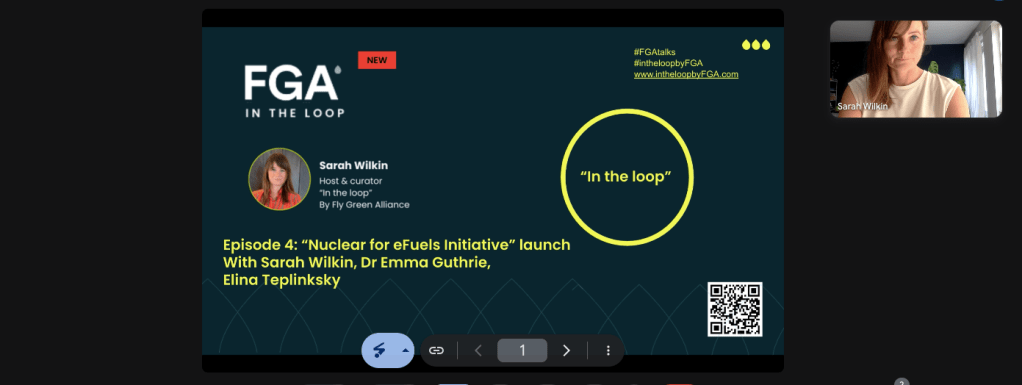
On August 12th , 2025 Fly Green Alliance hosted the launch the Nuclear e-Fuels Initiative (NEFI) on the 4th episode of “In the Loop”. Founder and CEO Sarah Wilkin shared her own evolving perspective on nuclear which began in 2023 after realising the vast amount of energy that will be required for aviation decarbonisation.
Following this realisation FGA and Wilkin grew in support for nuclear by attending various conferences such as speaking on a panel at World Nuclear Association, at the International Atomic Energy Agency (IAEA), representing aviation, which discussed the application of small modular reactors (SMRs) in 2024. Following this Wilkin attended the CERAWeek conference in Houston where Google and Amazon signed to support the World Nuclear Association’s tripling of nuclear capacity by 2050. NEFI is focused not just on SAF but varying modes of transport to cover different industries involved. NEFI aims to connect the nuclear, hydrogen, and eFuel industries to create a collaboration for strengthening production and advocacy, as well as investment.
Co-presenting and fellow collaborators at the launch were Elina Teplinsky founder of the Nuclear Hydrogen Initiative at Pillsbury Winthrop Shaw Pittman LLP and Dr. Emma Guthrie CEO of the Hydrogen Energy Association.
Elina Teplinksy works as a leader in Hydrogen and Nuclear and Partner at Pillsbury Winthrop Shaw Pittman and discussed how there has been little discussion between the nuclear and hydrogen industries displaying the need for communication. Teplinksy explained at the launch “there was really a need to pull the two communities together. The mission statement as you can see is just to raise awareness about the potential of nuclear hydrogen advance policies recommendations address technical and regulatory challenges advance partnerships as well as improve access to finance.” Teplinksy described the difficulty of navigating rapidly changing policy framework and used the US as a case study particularly with the credits provided by the Inflation Reduction Act that have been revised by the Trump Administration in the One Big Beautiful Bill Act. Elina also described a global map of all low carbon hydrogen projects that has been constructed which can be found here. Teplinksy also described various pathways for production of hydrogen such as low temperature hydrolysis, high temperature hydrolysis, and thermo-chemical methods. She described thermo-chemical as having potential but largely being at lab-scale now, however, high temperature hydrolysis may have some production cost and efficiency advantages, while most current technology is low temperature hydrolysis. Elina also laid out how current hydrogen production is dominated by steam reformation without carbon capture, however there is a growing focus on steam reformation with carbon capture or green hydrogen with the use of nuclear or renewables. Renewables have some disadvantages associated with them compared to nuclear, as nuclear provides a strong baseload of power and small modular reactors can be placed very close to production of hydrogen. This is because SMRs are not subject to the same emergency zones as larger
facilities as Elina pointed out.
Dr. Emma Guthrie has been CEO of the Hydrogen Energy Association for roughly 8 months and has had broad experience in the hydrogen space, such as leading efforts for hydrogen fuel cell vehicles and infrastructure in London and Copenhagen. The Hydrogen Energy Association has over 100 members across the hydrogen sector and advocates for the positive role hydrogen can play in the energy and
transport system. She mentioned the variety of pathways for hydrogen production such as steam reformation with carbon capture, electrolysis, and pyrolysis along with the potential for application not just as direct fuel source but also as chemical feedstock like with SAF and e-fuels. She stated the HEA is “looking to support pathways that that achieve that aim of of ultimately providing a low carbon or
decarbonised energy carrier for fuel and energy use”. Dr. Guthrie Highlighted a couple of working groups in HEA such as the nuclear enabled hydrogen working group or hydrogen derivatives working group both relevant to NEFI. Dr. Guthrie gave the powerful message for NEFI: “No single organisation can can achieve or move things forward in isolation. So as an association, we do advocate for the the work of our members, but we also, as I say, really want to be a supportive voice in in the sector in general.” She further elaborated on the UK government’s DESNZ missions of kickstarting economic growth and establishing the UK as the Clean Energy Superpower. Particularly notable is the commitment to increase
nuclear capacity in the next 30 years more than the last 70, however, Dr. Guthrie highlighted how the UK government hasn’t specifically mentioned nuclear enabled hydrogen thus creating the need for NEFI.
She also mentioned how the UK governments SAF mandate seems to be a powerful push that could lead to results.
Wilkin announced that Fly Green Alliance’s membership “In the loop” has now 15 members since January 2025 will support the work of NEFI. Moving forward the coalition will look into its accelerators and blockers, map its signatories along the production process, and aim to particularly address perceptions of nuclear. Sarah displayed the pillars of NEFI as: 1. Global reach/every sector travels 2. Communication and Perception Change and 3. Networking and Business Development. Wilkin will be attending several conferences upcoming soon such as the World E- Fuels summit, Global Synthetic Fuels Assembly, and Argus Biofuels, and will announce NEFI at these events. Wilkin also mentioned the screening of Nuclear Now by Oliver Stone, along with mentioning the rather positive response so far.
Wilkin highlighted the need for increasing supply of SAF over the coming years along with meeting low carbon targets for net zero. FGA thanked all those who attended and is excited for future collaboration and NEFI.
With thanks to Bryan Carroll, Biosystems Engineer a recent graduate from Clemson, South Carolina, for the summary of the launch, edits by Sarah Wilkin.
Read more on:



 Fly Green Alliance (FGA) - sustainable aviation fuel (SAF), thought leaders, travel & transport, fuels, multi modal, SAF
Leave a comment